

Abstract: This study examines the population dynamics and distribution changes of the white eared pheasant (Crossoptilon crossoptilon) in Kehe Township, Aba County in China. Building on this analysis, it further explores the ecological and anthropogenic drivers behind these changes. Data were collected through semi-structured interviews and participatory mapping. The findings indicate that, although the overall distribution range of the white eared pheasant has remained relatively stable, its population density has declined markedly. Historical drivers such as hunting and deforestation were the primary causes of population decline before the 1990s. Climate change has emerged more recently as a key factor constraining population recovery.
Keywords: White eared pheasant; Semi-structured interview; Population dynamics; Protection
1. Introduction
The white eared pheasant (Crossoptilon crossoptilon, Figure 1) is a bird belonging to the Galliformes order, Phasianidae family, Crossoptilon genus (Cheng et al. 1978). It is a big white feathered pheasant with black downy tail feathers. This bird is an indigenous and unique species in China, distributed from southeastern Xizang to western Sichuan. They often live in groups and inhabit scrublands and forests at an altitude of 3,000-4,000 meters (MacKinnon 2022). As an omnivorous bird, the white eared pheasant feeds on the tender roots, stems, leaves, and seeds of plants; juveniles also consume larva of insects.
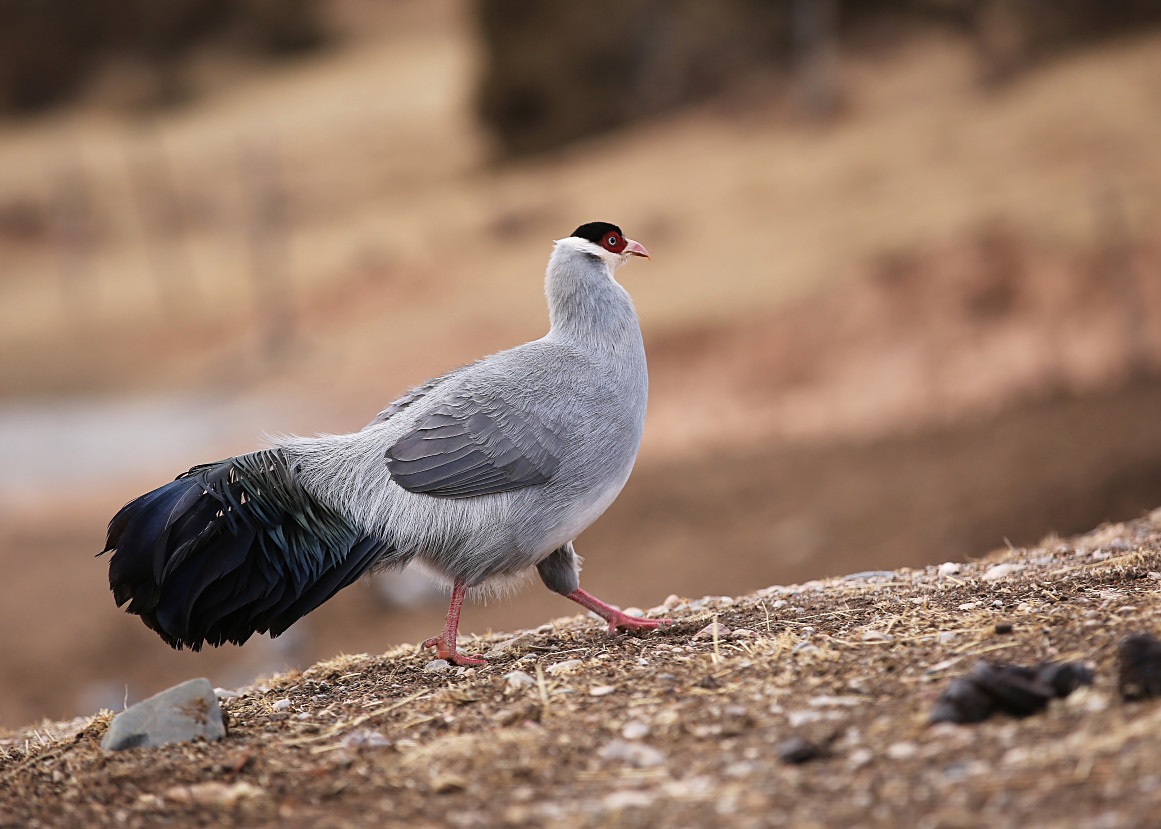
The white eared pheasant is a protected species, categorized as a National Second-Class Protected Animal in China, a vulnerable species in the China Red Data Book of Endangered Animals, a species listed in Appendix Ⅰ of the Convention on International Trade in Endangered Species of Wild Fauna and Flora (CITES), and a near threatened (NT) species in the IUCN Red List of Threatened Species (International Union for Conservation of Nature 2016; Zheng & Wang 1998; CITES 2016). This exclusivity makes it a potential biological indicator inherently linked to China’s regional ecosystems, particularly the fragile alpine environment of the Qinghai-Xizang Plateau and its surrounding areas. Studying such a species allows for focused insights into the ecological dynamics of these unique habitats. Meanwhile, as a rare species, tracking fluctuations in its population offers a direct and sensitive measure of the success or failure of conservation initiatives.
Studies on changes in wildlife populations can provide a scientific basis for wildlife conservation. Currently, most research in China mainly focuses on endangered species, flagship species, and keystone species, such as the giant panda (Ailuropoda melanoleuca), amur tiger (Penthera tigris altaica), Tibetan antelope (Pantholops hodgsonii), and snow leopard (Panthera uncia). (Yu et al. 2011; Wei & Xu 2020; Kong et al. 2021; Wang et al. 2022; Gao 2023; Gao et al. 2023; Li et al. 2025). In contrast, research on the genus Crossoptilon remains relatively limited. Existing studies have primarily focused on the brown eared pheasant (Crossoptilon mantchuricum) ( Li & Wei 1993; Zhang et al. 2000; Liu et al. 1991). Research on the white eared pheasant has largely concentrated on nesting site preferences. These studies suggest that white eared pheasant prefer a site close to water resource, full of vegetation coverage, and low in shrub coverage (Gema et al. 1999; Lu & Zheng 2001,2002,2003; Jia et al. 2005a,2005b; Wang et al. 2005).
Notably, there is a critical gap in research that combines analyses of population dynamics with spatial distribution change. To address the gap, this study offers a preliminary and exploratory examination of how the population and distribution of white eared pheasant in Kehe Township have changed over time. It also explores the anthropogenic and ecological factors influencing these changes and discusses local attitude towards this bird species.
2. Method
To collect data, I conducted semi-structured interviews and participatory mapping from August 6, 2025 to August 9, 2025 in Kehe Township (Figure 2), a place under the jurisdiction of Aba County, on the eastern Qinghai-Xizang Plateau. These methods were chosen to integrate local ecological knowledge with spatial distribution data, allowing for a community-based understanding of population change. Kehe Township has altitude over average 3000 meters, with lots of spruce (picea) (Ang 1993). The high altitude and high forest coverage in Kehe Township provide white eared pheasant a suitable climate for living. Kehe Township is a residential area mainly for ethnic Tibetan people. The majority of local people practice Vajrayana Buddhism.

In total, I interviewed 10 participants. All of them were residents in Kehe Township, including 9 males and 1 female, aged approximately from 29 to 70 years old. Basic information about interviewees is provided in Table 1. My interview questions focused primarily on: number and distribution change, the potential reasons for changes, and the cultural significance of this bird. For participatory mapping, participants were invited to mark the location where they had observed white eared pheasant during their childhood (between fifty and sixty years ago), and in recent years; as well as the maximum flock size of white eared pheasant at each respective location on Google Earth (https://earth.google.com). In addition, I used ArcGIS to produce kernel density maps to visualize changes in the spatial concentration of white eared pheasants.
| No. | Interview Time | Gender | Age | Occupation | Village of Residence |
|---|---|---|---|---|---|
| 1 | Evening of August 6, 2025 | Male | 29 years old | Semi-farming and semi-pastoralism, earning money by collecting cordyceps | Seri Village |
| 2 | Morning of August 7, 2025 | Male | 50 years old | Making and selling cowhide products | Yicun Village |
| 3 | Afternoon of August 7, 2025 | Male | 52 years old | Herding livestock in childhood; once served as Secretary of Geduo Township | Seri Village |
| 4 | Afternoon of August 7, 2025 | Male | 67 years old | Unclear | Seri Village |
| 5 | Evening of August 6/August 7, 2025 | Male | 45 years old | Monk | Nimenda Village |
| 6 | Morning of August 8, 2025 | Male | Unclear | Unclear | Caokun Village |
| 7 | Afternoon of August 8, 2025 | Male | 70 years old | Hunting white-browed pheasants in childhood; later became a monk | Nimenda Village |
| 8 | Morning of August 9, 2025 | Male | 41 years old | Herding livestock | Nimenda Village |
| 9 | Afternoon of August 9, 2025 | Female | 34 years old | Unclear | Seri Village |
| 10 | Afternoon of August 9, 2025 | Male | 35 years old | Unclear | Seri Village |
3. Results and Discussions
3.1 Changes in distribution and population
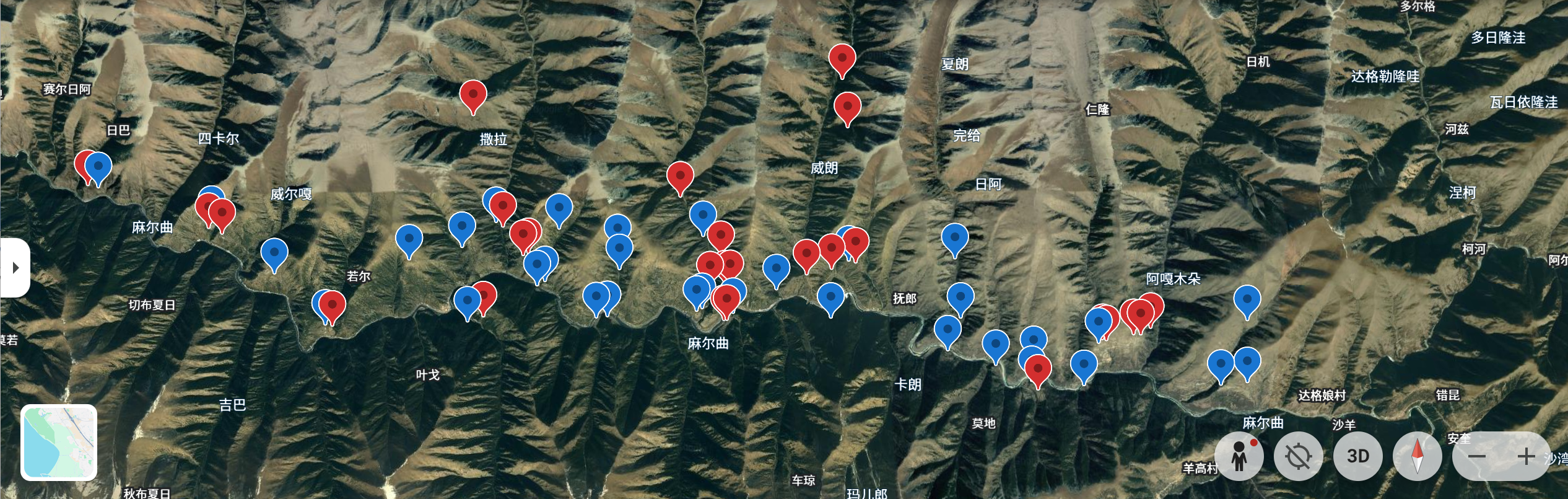
Red points represent the species’ distribution in the past decade, while blue points indicate its distribution fifty years ago.
The distribution ranges of white eared pheasants in Kehe Township fifty years ago and at present are shown in Figure 3. The species is primarily distributed in area near rivers, down in the valleys, and along streams inside mountains. ArcGIS analysis indicates a 93.5% overlap between past and present distribution ranges.
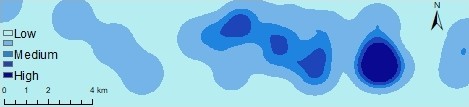
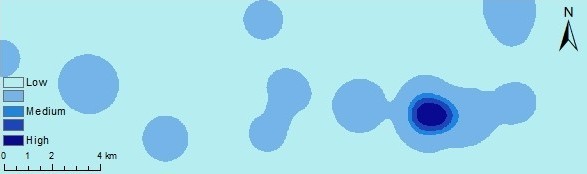

Figure 4: Kernel density maps of white-eared pheasants in Kehe Township. (A) Kernel density fifty years ago; (B) Kernel density at present; (C) Changes in kernel density between fifty years ago and the present.
Figure 4A and figure 4B illustrate the distribution density fifty years ago and in the recent decade, respectively. Although the total distribution area varied little over time, the distribution density had experienced a drastic decrease. In the past, white eared pheasants were found in high concentration at diverse locations, and the total density at this given area was high. At present, however, only one spot remains with abundant white eared pheasants, while most other locations had a drastic decline in distribution density. This pattern is further illustrated in Figure 4C, which shows that only one spot at Kehe Township experienced a density increase, whereas most locations encountered a density decrease. Therefore, although the distribution area did not vary greatly between fifty years ago and the present, the data suggest that the density of white eared pheasants may have experienced a drastic decline.
Winter flock sizes of white eared pheasants also provide evidence of population change. My interviewees consistently reported an overall decline in population size. Sixty years ago, there were still a lot of white eared pheasants, with several interviewees recalling that they could see 100 birds living together in a group at winter. In contrast, today they could only see 30 birds in a flock during winter. Specifically, flock size was initially decreasing but is now in a recovery. In other words, despite the magnitude of the decrease exceeding increase, currently the bird’s population is experiencing an increasing trend. The population number reached its lowest point around 50 years ago, in which interviewees could only saw 10 birds in a group during the winter. The population finally recovered a little bit starting by the 21st century, with interviewees observing 30, 50, 60 birds in a winter flock.
3.2 Causes of changes
All interviewees identified large-scale hunting over the past few decades as the primary factor contributing to population decline, which aligns with the corresponding political orientations toward hunting during distinct historical periods. All the interviewees said that hunting was a prevalent activity from the 1950s to 1980s. During that period, organized hunting teams came to Kehe Township and hunt wild animals, and local residents later joined in to improve their living standards and gain more food to eat. This wave of hunting was not an isolated local phenomenon, but closely tied to the broader historical and policy context of the rea.
Seventy years ago, during the Collectivization Period and the Cultural Revolution (1950-1980), government viewed wild animals as economic resources. They encouraged people to hunt. There were even big organizations that held hunting events to acquire meat and fur. Against this backdrop, mainland hunters also came into Aba and killed wild animals for money, further intensifying the pressure on local wildlife. White eared pheasants were inevitably harmed in this process, leading to a sharp population decline (Zhu 2020; Ang 1993). Starting around the 1990s, more and more political efforts are put into the conservation of wild animals. Such as Law of the People’s Republic of China on the Protection of Wildlife, which was published in 1988, prohibited hunting wild animals; The National Key Protected Wildlife List categorized white eared pheasant as a State Second-Class Protected Animal in 2021; and The IUCN red list considered white eared pheasant as nearly threaten species in 2004. These efforts prohibit the hunting of wild animals, thereby contributing to the population recovery.
Deforestation also indirectly devastated white eared pheasants’ habitats. Large-scale logging for house construction, has severely damaged the habitats of white eared pheasants. An interviewee said that during 1987 to 1989, numerous trees were cut down for the construction of houses. Forests are the natural habitat of white eared pheasants, as they rely heavily on dense vegetation for survival. Trees also provide them with places to perch, nest, and hide from predators, and vegetation could help them to keep their new-born babies safe from predators. Moreover, deforestation isolated the previous continuous habitat for white eared pheasants. Fragmented patches of habitats make it harder for them to find suitable nesting sites and maintain the original safety.
Lastly, the alteration in climate also imposes threat to the white eared pheasants’ population. According to most of the interviewees, the temperature at Kehe Township has greatly increased. Existing studies also suggested that forty to fifty years ago, the highest summer temperature was below twenty degrees Celsius, but during the past ten years, summer temperature sometimes reached thirty degrees Celsius (Ang 1993; Kang et al. 2022). As a result, the hot temperature might not be suitable for white eared pheasants to live, since they are plateau dwelling avians. In addition, the decline in precipitation could mitigate water resources, hence limiting the amount of water white eared pheasants could utilize.
Overall, large-scale hunting and deforestation were the main drivers of population decline before the 1990s, while recent conservation policies have enabled partial recovery. Climate change, with its impact becoming increasingly significant over the past three decades, is the primary reason for the slow recovery of white eared pheasants’ population in recent years.
3.3 Local attitudes
Under the cultural influence of Vajrayana Buddhism, Local residents refrain from killing wildlife, including white eared pheasants, as they uphold the equality of all living beings and believe killing would bring negative karmic consequences to their samsara.
During this research, an interesting viewpoint I discovered is that local interviewees believe that when hunters kill a white eared pheasant, it is easier, in the future, for them to hunt more birds. This finding is out of the expectation, since it is against their religious belief. Nevertheless, I suggest that the two diametrically opposed traditional beliefs coexist in people’s minds, only the dominance varied throughout different time periods. Below is my speculation:
Prior to the 1960s, people earned their living primarily by animal husbandry and led a self-sufficient lifestyle. Ahimsa, the belief in refraining from taking life, was the dominant ethos, and the behavior of hunting was in a recession. During the Collectivization Period and the Cultural Revolution, around 1950s to 1980s, people had a hard time sustaining life, they were so poor that there is insufficient food to eat. Under such circumstance, people have to hunt wild animals for food despite their original believe of ahimsa. Consequently, the believe of “take life” (killing living beings) dominates the other. Starting from the 1980s, China’s economy is expanding in a fast pace. Driven by economic interests, people hunted wild animals to gain economic benefits, which led to the continued dominance of the belief “take life” (killing living beings). In the 1990s, with international legislations and the improvement of overall living status, people’s belief of ahimsa rose again. Accordingly, people stop hunting animals and white eared pheasants’ number begin to recover. These two beliefs coexist and shift in dominance depending on people’s living conditions.
In sum, two distinctly different attitudes toward white eared pheasants coexist in the minds of local residents. People’s attitudes toward these birds are influenced by their living conditions; the two attitudes compete with each other under different circumstances, ultimately affecting the survival status of white eared pheasants. This also constitutes the underlying reason for anthropogenic factors behind the changes in the white eared pheasants’ population.
4. Conclusions
This study investigated population and distribution changes of the white eared pheasants (Crossoptilon crossoptilon) in a township on the eastern Qinghai-Xizang plateau. Preliminary results showed that although its total distribution range remained stable, its population density has declined sharply. Drivers of these changes include hunting and deforestation, which had a severe impact in the past. Currently, environmental changes, such as risen temperature, reduced precipitation, and shrunken forest vegetation, likely are exerting a more intense effect. The population decline of white eared pheasant might also have to do with local attitude. Under different circumstances, local people have different attitudes towards wildlife in general and on white eared pheasant in particular, reflecting the coexistence and shifting dominance of ahimsa and hunting for survival. Thus, the population change of the white eared pheasant reflects not only environmental change but also the shifting mindset of local residents, demonstrating the deep interconnection between ecology and culture.
It should be noted that this study has several limitations that constrain the depth of its findings. First and foremost, due to time limitations, the study relied only on 10 interviewees at a limited geographic range, a sample size insufficient to capture deep analysis of the environmental conditions in Kehe Township. Future research will expand the sample size and range, ensuring the quantity and credibility of the research. Furthermore, all data collected through interview were based on interviewees’ memories, which are prone to inaccuracies. Future research should complement semi-structured interviews with quantitative historical data, to solidify and provide support for interviewees’ response.
As a mid-trophic avian, the white eared pheasant plays an irreplaceable role in forest ecosystems. They can facilitate energy flow between producers and higher trophic consumers, and regulate vegetation growth through foraging. However, conservation efforts and research attention remain disproportionately focused on top predators, flagship species, or highly endangered animals. The white eared pheasant has been marginalized in both academic research and local conservation practices. This neglect is concerning because declines in mid-trophic species can disrupt the trophic cascade. Therefore, future conservation efforts should also put attention to mid-trophic species, which are vital for ecosystem stability.
5. Acknowledgements
I would like to express sincere gratitude to my mentor Dr. Gao Yufang for invaluable guidance throughout the research and writing this essay. Special thanks to all the local residents in the environmental protection group for arranging accommodation and connecting interviewees for me. I am deeply grateful to all the interviewees who answers questions and provide meaningful data for this research.

References
Ang, T. (Ed.). (1993). Annals of Aba County. Nationalities Publishing House.
Cheng, T. H., Tan, Y. K., Lu, T. C., et al. (1978). Fauna of China. Aves. Volume Ⅳ: Galliformes. Beijing: Science Press.
Convention on International Trade in Endangered Species of Wild Fauna and Flora (CITES). (2023) CITES Appendices I, II and III. http://www.cites.org
Gao, Y. (2023). Envisioning coexistence: Snow leopards and Tibetan herders in China’s first national park. Yale University.
Gao, Y., Wang, Y., Lee, A. T. L., Liu, Y., Luo, Y., Orrick, K., Alexander, J. S., Sangpo, J. T., et al. (2023). Contextualizing sociodemographic differences in Tibetan attitudes toward large carnivores. Conservation Science and Practice, 5(12), e13049.
Gema, J. C., Dong, D. F., & Long, W. X. (1999). A preliminary study of the ecology of White Eared-pheasant. Chinese Journal of Zoology, 34(1), 26–28.
International Union for Conservation of Nature (IUCN). (2016). The IUCN Red List of Threatened Species (Version 4). Retrieved from http://www.iucnredlist.org
Jia, F., Wang, N., & Zheng, G. M. (2005a). Habitat selection and spatial distribution of White Eared-pheasant in early breeding period. Acta Zoologica Sinica, 51(3), 383–392.
Jia, F., Wang, N., & Zheng, G. M. (2005b). Analysis of roosting site characteristics of White Eared-pheasant flocks in winter.Chinese Journal of Ecology, 24(2), 153–158.
Kang, S., Zhang, Q., Zhang, Y., Guo, W., Ji, Z., Shen, M., Wang, S., Wang, X., et al. (2022). Warming and thawing in the Mt. Everest region: A review of climate and environmental changes. Earth-Science Reviews, 225, 103911.
Kong, L., Xu, W., Xiao, Y., et al. (2021). Spatial models of giant pandas under current and future conditions reveal extinction risks. Nature Ecology & Evolution, 5, 1309–1316.
Li, X. T., & Wei, Y. X. (1993). Brown eared-pheasant of Beijing. China Nature, (4), 14–15.
Li, X., Wei, C., Chen, X., Jia, D., Li, P., Liang, S., Jikmed, A., Gao, Y., Zhao, X., Chu, M., et al. (2025). First large-scale assessment of snow leopard population in China using existing data from multiple organizations. Biodiversity and Conservation, 34(3), 1039–1055.
Liu, H. J., Su, H., & Ren, J. Q. (1991). The China Phasianids: Brown Eared-pheasant (pp. 12–21). Beijing: China Forestry Publishing House.
Lu, X., & Zheng, G. M. (2001). Habitat selection and use by a hybrid of White and Tibetan Pheasants in eastern Tibet during the post-incubation period. Canadian Journal of Zoology, 79, 319.
Lu, X., & Zheng, G. M. (2002). Habitat use of Tibetan Eared Pheasant Crossoptilon harmani flocks in the non-breeding season. Ibis, 144, 17.
Lu, X., & Zheng, G. M. (2003). Reproductive ecology of Tibetan Eared pheasant Crossoptilon harmani in scrub environment, with special reference to the effect of food. Ibis, 145, 657–666.
MacKinnon, J. R. (2022). Guide to the birds of China. The Commercial Press.
Wang, N., Jia, F., & Zheng, G. M. (2005). A study on nest-site selection of White Eared-pheasant. Journal of Beijing Normal University (Natural Science Edition), 41(2), 190–193.
Wang, Q. S., Wen, L., & Su, X. K. (2022). Spatial-temporal pattern changes of Tibetan antelope’s habitats on the Qinghai-Tibetan Plateau under climate change scenarios. Acta Ecologica Sinica, 42(22), 8985–8993.
Wei, Z. Q., & Xu, Z. R. (2020). Habitat distribution of Tibetan antelope in the Chang Tang Plateau and influential factors. Acta Ecologica Sinica, 40(23), 8763–8772.
Yu, T., Wu, J. G., Smith, A. T., Wang, T. M., Kou, X. J., & Ge, J. P. (2011). Population viability of the Siberian Tiger in a changing landscape: Going, going and gone? Ecological Modelling, 222(17), 3166–3180.
Zhang, Z. W., Zhang, G. G., & Song, J. (2000). The population status and conservation strategy of Brown eared-pheasant. In Studies on Chinese Ornithology: Proceedings of the 4th Ornithological Symposium of Mainland & Taiwan, China (pp. 49–55). Beijing: China Forestry Publishing House.
Zheng, G. M., & Wang, Q. S. (1998). China Red Data Book of Endangered Animals (Aves) (p. 259). Beijing: Science Press.
Zhu Z. (2020). The Evolving Ecological Culture of Tibetan Pastoralists and Its Interaction with Environmental Changes in the Sanjiangyuan Region, Qinghai Province. Peking University.